


What Are Smart COIs and Why They're the Only Way to Track Insurance Coverage in Real Time
A Smart COI is a certificate of insurance that updates automatically whenever the underlying policy changes, reflecting cancellations, limit reductions, and schedule modifications within seconds rather than waiting for the next renewal cycle. Traditional COIs are static PDFs accurate only on the day of issue, and on average an insurance policy changes five times per year according to Certificial's 2026 product data, which means each certificate on file drifts further from actual coverage every week. Smart COIs use the standard ACORD form but connect directly to the agent's management system through the Smart COI Network of over 25,000 agencies. Last updated: May 2026
Imagine managing your business finances with three-month-old bank statements instead of real-time transaction data. You'd make decisions based on outdated information, unaware that checks have cleared, deposits posted, or your balance has changed dramatically.
This is exactly how traditional certificates of insurance work - as a static PDF capturing one moment in time. As Certificial CEO Peter Teresi explains, "a COI is one day of evidence, not one year of evidence." Between the day a certificate is issued and the day a claim occurs, everything can change.
On average, an insurance policy changes five times per year. Equipment gets added or removed from schedules, coverage limits adjust mid-term, and policies get canceled for non-payment. Each modification makes the certificate on file less accurate, creating a growing gap between what your records show and what coverage actually exists.
What Is a Smart COI?
A Smart COI is a certificate of insurance that continuously updates with current policy information. Unlike traditional COIs that become outdated as soon as the insurance Agent makes a change to one of the policies, Smart COIs reflect the current state of coverage at all times.
Smart COIs still use industry-approved ACORD forms. Instead of extracting policy data once to create a static PDF, Smart COIs connect directly to the system where agents manage their clients' insurance policies. When an Agent makes any change - cancellation, coverage reduction, renewal, schedule modification - a Smart COI reflects this change within seconds.
The Smart COI Network now includes 25,000+ insurance agencies providing over 90% of commercial business insurance in the US and Canada. Policy data updates instantly, ensuring certificate holders always see current coverage status.
Traditional COI vs. Smart COI
Traditional Certificate: Agent creates PDF from current policy data. Becomes outdated the moment an insurance Agent makes a change to any of the poilicies. Requires manual re-submission for updates. Certificate holder sees only what's on the PDF.
Smart COI: Automatically generated from policy database. Always reflects current insurance policies. Updates automatically when policy changes. All parties see real-time policy data.
The distinction matters because your risk exposure depends on whether insurance coverage actually exists when an incident occurs, not whether you have a compliant document from three months ago.
Two Critical Problems Smart COIs Solve
Mid-Term Cancellations
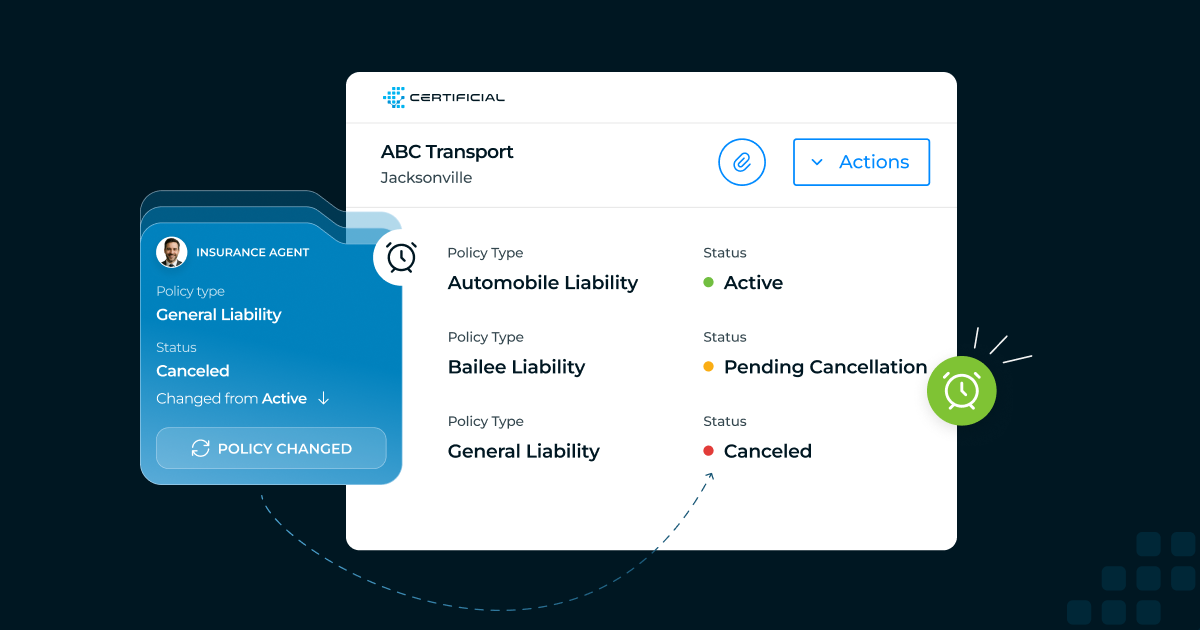
What happens when an accident happens on site - and the Vendor's insurance policy turns out to have been canceled months before? The WAINWRIGHT v. et al., Third-Party Defendants. (2003) court ruling was clear - the certificate holder has no coverage and is essentially left holding the bag.
The certificate holder company (a general contractor) tried arguing that the policy was not properly canceled because it was not notified. The court decided that the carrier "strictly complied with the notice of cancellation provisions by mailing a timely notice of cancellation to the insured and the insured's Agent or broker”.
Notifying additional insureds of a cancellation was only a "courtesy" policy - not a legal obligation.
Christopher A. Arcitio, Of Counsel at Kaufman Dolowich LLP, explains what happens legally when policies are canceled mid-term:
"If a subcontractor's insurer validly cancels a subcontractor's policy, General Contractors can find themselves litigating personal injury lawsuits on their own, without the benefit of a subcontractor's insurance policy at play. According to the New York Insurance Law requirements, insurance companies must mail a timely notice of cancellation to the insured and the insured's authorized Agent or broker. However, they generally do not need to inform anyone else in order to cancel the policy—which includes a certificate holder."
The solution: "Systems that detect insurance policy cancellations immediately as they occur, without relying on timely 30 Days notices would ensure Certificate Holders have viable Subcontractors/Vendors with legitimate insurance for risk transfer when personal injury accidents happen." (Link to the full legal opinion.)
Smart COIs do exactly that - they notify certificate holders of insurance policy cancellations immediately, as soon as the Agent cancels the policy in their system.
Schedule-Level Coverage Gaps
.png)
Beyond complete policy cancellations, mid-term changes can also create hidden exposures. One common change is when specific vehicles or equipment get removed from policy schedules.
What happens if an accident was caused by a vehicle that was listed on an Auto Liability policy, and then removed?
We asked Christopher A. Arcitio, Of Counsel at Kaufman Dolowich LLP in New York City, what happens legally when this scenario plays out.
"If contractors fail to maintain updated COIs, they face significant legal and financial exposure. In New York, when a contractor doesn't update certificates to reflect new vehicles used at their sites, insurance carriers can deny coverage if an accident occurs."
However, current documentation provides legal protection: "Current COIs serve as critical evidence of an insurer's intent to provide coverage for new vehicles. Courts can even stop insurance companies from denying coverage when contractors have relied on certificates to their detriment." (You can read the full legal opinion here).
The key word here is "current" - which is exactly what Smart COI technology helps to accomplish.
Smart COIs monitor specific assets covered on policies - vehicle VINs, equipment serial numbers, covered locations - and update automatically when items are added or removed. This provides the "current documentation" courts recognize as evidence of coverage intent.
Industry Recognition: The ACORD Partnership
In a significant validation of the technology, Certificial partnered with ACORD to advance Smart COIs as the future of insurance verification. ACORD, the standards-setting organization for the insurance industry, recognized that rapid digitalization created a need for verification methods beyond static COIs.
"Partnering with forward-thinking technology providers like Certificial enables us to drive progress for both the industry and its customers, who will now be able to track live policy data in real time, in the industry-standard format," said Tanya Krochta, Chief Operating Officer at ACORD.
The partnership positions Smart COIs not as a proprietary solution, but as an industry-standard evolution of the ACORD 25 form itself.
Real Results: The PowerFlex Case Study
PowerFlex, a renewable energy company managing high-risk solar installations, struggled with traditional COI tracking.
The real-time cancellation monitoring solved a problem they'd considered unsolvable:
"Managing the risk of subcontractor policy cancellations used to feel like a problem we just had to live with. Collecting endorsements for Notice of Cancellation is notoriously difficult, especially when you're working with a large network of Subcontractors and Vendors. Even when you do get them, they're often ineffective: they can be delayed, misplaced, or buried in a mailroom. Certificial's Smart COI technology is the first solution I've seen that actually solves this problem. When a subcontractor's policy is canceled, we see it immediately in Certificial," - Matthew Dobras, Associate Director of Insurance at PowerFlex.
Getting Started with Smart COIs
The fundamental shift is from managing certificates to monitoring coverage. Traditional COI tracking tells you if a compliant document is on file. Smart COI technology tells you if coverage is actually valid right now - and alerts you within seconds when that changes.


C.svg)